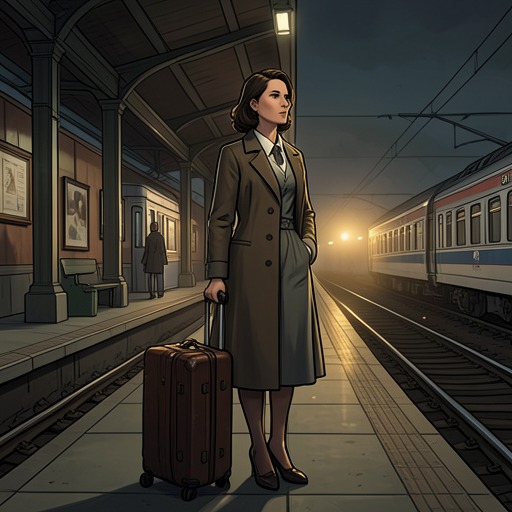
Irene
The Sun is Also a StarIrene is a security guard at the United States Citizenship and Immigration Services building in New York City whose routine attention to applicants creates an unexpected bond with Natasha Kingsley. For Irene, delaying a bin is not mere procedure: it is a way to make another person look up and acknowledge her. When Natasha later thanks her, that brief recognition reaches Irene during a suicidal crisis and helps turn a life of isolation toward care, treatment, and a new vocation. Ten years later, Irene’s work as a flight attendant brings her face to face with Natasha again.
Identity and Work at USCIS
Irene works at the security checkpoint, where applicants place their phones, headphones, bags, and other belongings in a gray bin before passing through a metal detector. Natasha sees her repeatedly during a week of visits and notices that Irene pauses the bin each day. From Natasha’s perspective, the guard is an anonymous official delaying an urgent attempt to get help. Irene’s own experience is almost the reverse: she loves her job because it supplies nearly all the human contact in her life. The work is not simply a routine she performs; it is the fragile structure holding her loneliness at bay.
Irene deliberately makes applicants notice her. She catches each bin with one gloved hand, holding it just long enough for its owner to look up and meet her eyes. Some people offer a reluctant morning greeting; others ask how she is. Even these brief exchanges matter to her. She wishes she could remove her gloves and touch the keys, wallets, and loose change in the bins, as if the objects might let her sense something of the lives they belong to. But she cannot hold up the line indefinitely, and each applicant eventually passes out of her reach. Her careful delays are therefore both a bid for connection and a practice bounded by the job’s demands.
The gap between Irene and Natasha’s understanding of the checkpoint gives the scene its quiet irony. Natasha assumes that Irene is indifferent or obstructive; in reality, Irene is looking for contact with the very people who barely register her. When the same teenage girl returns, still focused on her phone and hot-pink headphones, Irene recognizes her as a familiar presence. Natasha’s glance up makes Irene feel less alone, even though Irene does not speak her welcome aloud. A small exchange of attention, unnoticed by Natasha at the time, becomes the beginning of their consequential connection.
Loneliness and Suicidal Crisis
Irene’s need for these interactions becomes acute after a particularly bad night, when her loneliness feels overwhelming. On her lunch break, she downloads an album by Nirvana and listens to it three times in a row. In Kurt Cobain’s voice she recognizes a loneliness and longing that seem to approach a breaking point. Learning that Cobain’s story did not have a happy ending deepens her despair rather than relieving it. She has been thinking about suicide intermittently for years; the music gives shape to feelings she has struggled to articulate, and she writes a note as she decides that the day will be her last.
The novel presents this crisis as serious, but not as an inevitable conclusion to Irene’s isolation. At the same time that Irene is privately making her plan, Natasha is trying to find help with her family’s impending deportation. Natasha has no reason to know what is happening inside the guard’s life, just as Irene does not know the full weight of Natasha’s circumstances. Their parallel desperation makes their eventual connection especially striking: one woman arrives at the checkpoint seeking a way to remain in the country, while the other is relying on each passing applicant to keep her connected to the world.
Natasha’s Message and Its Consequences
After Natasha meets the case officer Lester Barnes, she leaves him a voicemail asking him to thank the security guard. She describes Irene by her long brown hair, sad eyes, and habit of touching applicants’ belongings, then recalls Irene’s name just before ending the message. Natasha does not know that her acknowledgment is arriving at a critical moment. She intends it as gratitude for a delay that had frustrated her; for Irene, the message confirms that someone noticed her as a person.
Ten years later, Irene remembers the message as the beginning of a change, not as a miraculous cure. Barnes had stopped at her station and told her that a girl had called to say thank you. Irene did not know precisely what Natasha was thanking her for, but the fact that someone had made the effort to reach her shifted something. It was enough for her to call a suicide prevention hotline. The hotline led to therapy, and therapy to medication that continues to help her live. The sequence matters: Natasha’s gratitude interrupts Irene’s isolation, while sustained support helps her continue beyond that moment.
A New Vocation
Two years after the message, Irene leaves her job at the United States Citizenship and Immigration Services building. She remembers that, as a child, she dreamed of becoming a flight attendant, and she makes that dream her new direction. Her later life is described as simple and happy, but her experience of loneliness remains important to the way she does the work. She knows how isolating an enclosed journey can feel and notices passengers who may need extra attention.
As a flight attendant, Irene comforts people flying home for funerals and holds the hands of passengers afraid of flying or of enclosed spaces. She thinks of herself as a guardian angel with metallic wings. The image transforms her former role without erasing it: at the checkpoint, she tried to keep applicants from disappearing behind their belongings; aboard the plane, she watches for passengers whose distress might otherwise go unseen. Her attentiveness is not presented as effortless benevolence. It grows from having experienced loneliness herself and from knowing how much a small act of recognition can matter.
Reunion and Narrative Significance
Ten years after Natasha’s message, Irene is making final checks on a flight. A young man in seat 7A writes in a small black notebook, while the woman in 8C wears earbuds and has a large curly Afro with pink-dyed ends. Irene recognizes the woman as the girl from the checkpoint, though the passage of time makes her doubt her identification. Natasha then tells Irene that she remembers her and gives her name. The young man, Daniel Jae Ho Bae, looks over the seat and addresses Natasha; his openly loving expression places Irene’s recognition within the reunion of the two people whose lives have crossed again.
Irene’s arc links an otherwise brief encounter at the security checkpoint to the novel’s later reunion. The connection runs in both directions: Natasha’s call helps Irene survive, while Irene’s deliberate pause at the bin helped bring Natasha into contact with people who could respond to her situation. The story does not claim that one person can resolve another’s circumstances through a single gesture. Instead, Irene’s crisis changes through a chain of human contact and continuing care, beginning with the moment someone sees her. Her return at the end gives that theme a concrete form: after years of wondering who thanked her, Irene is finally recognized by Natasha in person.